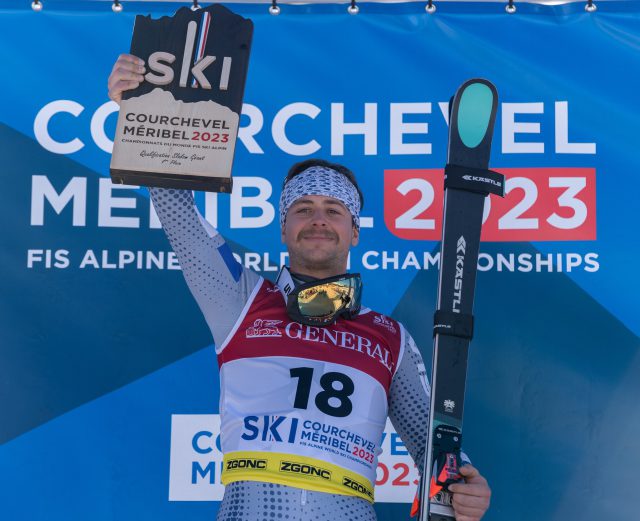
Péter Bohus’ interview with Benjamin Szőllős
(excerpt from the book “LEVEL UP – 40 Years of History & What Lies Behind It“)
BENJAMIN, THE OLDEST OF THE SZŐLLŐS SIBLINGS, HAS BEEN VISITING NIVELCO SINCE HE WAS A CHILD AND IS ALREADY THINKING ABOUT HOW HE WILL CONTINUE HIS LIFE AFTER SKIING.
– You currently attend two schools. Tell us about what you’re learning!
– There is a German academy that lets you work while studying there. I’m majoring in management and studying business management in this displaced institution in Vienna. It’s a three-year course, but I’m in my fourth year already. I’m trying to get to the end, but I’m not in a hurry to finish it because, in the meantime, I’ve started an online master’s degree in sports management at the University of London. I progressed with the Vienna one until I had only exams left, but since the coronavirus, they are asking for submissions instead. I cannot sit in front of the computer and write them while doing sports. I hope that now that the pandemic is over, I can pass the last two or three exams.
– What was your reason for going to such a school?
– At the end of 2018, after graduation, the goal is to do something in addition to skiing, and if others can do this in addition to their work, then it will work for me in addition to sports. In addition to the university, there is time for skiing because it has been and still is the first for me. The sports management major is roughly the same, only slightly closer to me because the examples and Péter Bohus’ interview with Benjamin Szőllős (excerpt from the book “LEVEL UP – 40 Years of History & What Lies Behind It“) BENJAMIN, THE OLDEST OF THE SZŐLLŐS SIBLINGS, HAS BEEN VISITING NIVELCO SINCE HE WAS A CHILD AND IS ALREADY THINKING ABOUT HOW HE WILL CONTINUE HIS LIFE AFTER SKIING. tasks come from sports. For now, this is more interesting to me, as I am more involved in the world of sports and skiing than in the corporate world. Of course, I’m slowly starting to focus on NIVELCO, but next February, there will be another world championship, so I’m preparing for that. Until then, the focus is on skiing.
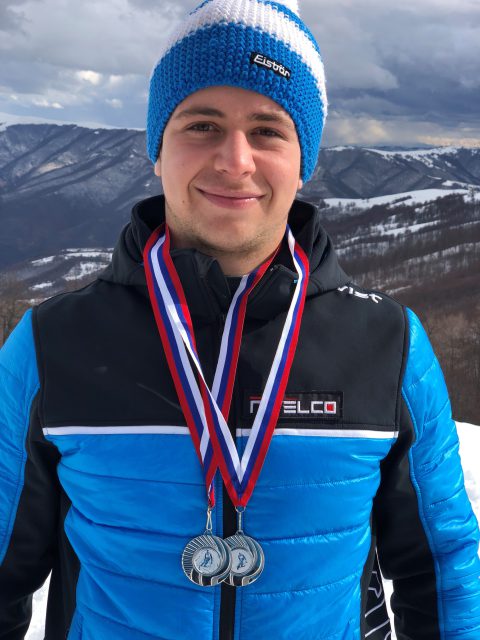
– What do you expect from this World Championship?
– I have reached a turning point. I have to decide whether, at this age, it still makes sense to fight to get into the Top 100 of the professionals, where you can make a living from skiing, or if the focus should be directed to NIVELCO and finish my school. I’m already qualified for the World Championship and said I’d push for it. I will continue if, during the season, I get results that pass the threshold required for professional sports. If not, I will probably quit.
– Would you give up racing altogether?
– I will still go to less serious competitions. Smaller competitions are organized in the Balkans, where everyone knows everyone and can be won or placed on the podium with less investment. When I was in Romania for an invitational competition in February, it was also an open international competition. Still, it was actually a promotional event, so competitors of my level were paid for the trip there and the hotel, and even had prize money. I went there thinking that I’d pick up the prize and, in the meantime, fit in a little party with my friends, but the Swedes also came, and the event turned out to be a very high-level international competition in the end, so I still had to compete for the money. I can still hack it out there for a year or two without more serious preparation.
– Do you think of yourself as an athlete or a student?
– As an athlete. Now that the last season is approaching, I’m already trying to find myself elsewhere, but skiing has always been in the first place so far. The trail has already been blazed for me. My parents and grandparents always told me to play sports as long as I enjoyed them. I should focus completely on it and see how far I can go with full dedication because afterward, I will have plenty of time to learn the trade needed to run NIVELCO. They also want me and my siblings to take over one day. I have to slowly find a way to manage a company that already employs more than two hundred people.
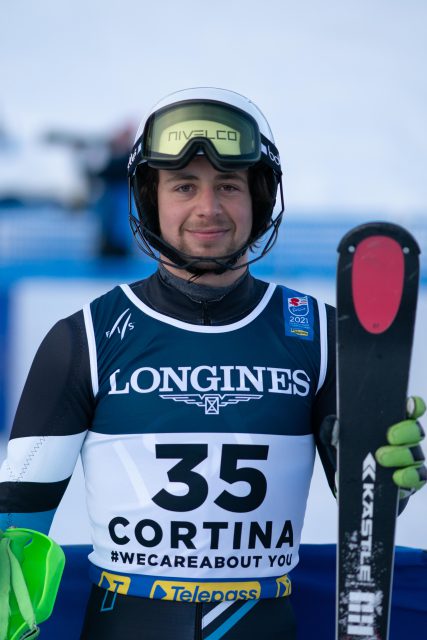
– You mentioned that the trail has already been blazed for you. On the other hand, you are the oldest of your siblings, so you tread the path before them. What do you think was difficult for you but not so much for them because of you?
– I wouldn’t call it an easy road because it is equally difficult for everyone. I would rather say that they had extra help in my person. In fact, Noa had more since she had two brothers. After all, they saw from me what works and what doesn’t. Skiing, for example, is a sport in which the visual element helps a lot, and they had someone close to them who skied at a higher level so that they could follow an example, something I didn’t have. Someone to boost me. After a while, my brother reached the same level as me, even higher. From then on, we boosted each other. But for a long time, I was the only one boosting him.
– Who is the better skier?
– He is now. There is a two-year difference between us, so we did not ski in the same age group. However, I saw Barni achieve better results in his own age group than I did in mine. I always had it in my mind that he would reach a higher level than me, that he would overtake me. When he overtook us, it was like we had been boosting each other for a long time, but in the last two years, he has really overtaken us.
– Have you always had a rivalry? Are you on good terms?
– Of course, constantly, but our relationship is still good. In Austria, we went to school together, lived in the same apartment, and trained in the same team. There was also a period when the two of us formed a team with a coach. We spent a lot of time together. Even during the many training sessions spent together, the rivalry was there every day. So, I wanted to be better not only in competitions but also in every training session. And, of course, he is too.
– Is there any other sport besides skiing that you like?
– Skiing becomes monotonous if a season drags on. Another sport helps me a lot. Calisthenics is the collective name for training with your own body weight, which requires maximum strength that you can hold for a few seconds. During the coronavirus pandemic, many people, including me, started doing it because the gyms were closed, and it offered a very good alternative form of exercise. It is rather upper body-focused, where the thick, heavy legs required for skiing are counterproductive and only makes the exercises more difficult, but I keep trying. Skiers always look for what will make them faster and how to win every race. Coordination is very important in skiing, and your brain’s coordination skills develop when you learn a lot of new moves and sets of moves, which is why all three of us tried many sports. We water skied and wakeboarded, and I roller skated a lot when I was little. We put out buoys and turns as if we were turning while skiing. We cycle a lot. I’m also hooked on windsurfing. What is important to me in sports and life is constantly improving and learning something new. It motivates me. In skiing, the course is 1 minute. In that 1 minute, you have to give everything you have: during the warm-up, you pump yourself up, you focus on it, you have that one minute, you stop at the bottom, and if your time is good, then you are a little happy. You cannot throw a hissy fit if your time is not good. This is a gentleman’s sport, so you must suppress many emotions.
– How do you usually relieve tension?
– You have to find something to let out. My siblings and I are huge metal fans, so we let off steam at concerts lately. I listen to music until the start of the race, and then if the race is good, I will play the song later until it has an effect.
– Which competition do you remember as being perfect?
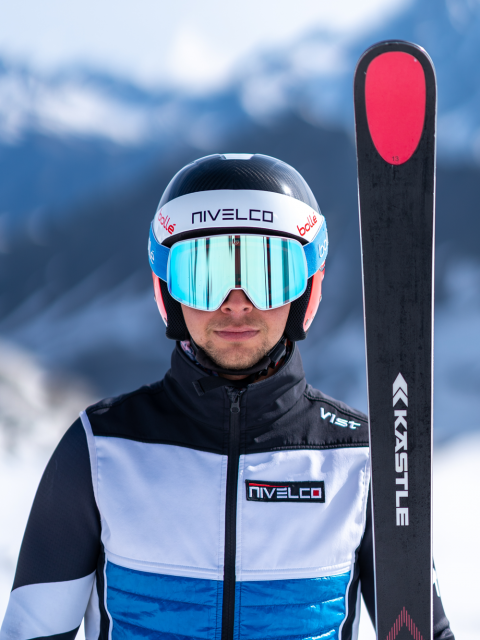
– There is no such thing as perfect, but maybe the 2019 Universiade, the university Olympics in Krasnoyarsk, Russia, in the middle of Siberia. The Russians did a great job. They organized a huge opening, Putin was there in person, and the whole thing was like an Olympics. It’s a college town, and everyone on campus has been kicked out so the athletes can live in one place. It was an incredible party. It was also broadcast by Eurosport. Slalom consists of two races. I was in the top thirty and managed to keep the lead when I got down. For example, the World Cup had a podium where the leader could sit, with a camera pointed at him. I was able to sit there for a while. There was also a Hungarian broadcast, and they said how good it was that I was still sitting there. That went very well.
– What would you miss the most if you had to stop skiing?
– The adrenaline and the boost that makes me want to give my best performance every day, and I even want to improve on it. I would then have to find this development compulsion elsewhere. But fortunately, I have a lot of hobbies in which I still want to improve my performance. I can also find this kind of motivation in my university studies. But of course, I will miss the racing itself a lot because I don’t like comparing myself to others outside the ski slopes. To compensate for the competition, I have to find something else.